
March 23, 2026 Board Meeting - Survey Results
This meeting was exclusively to review all survey results pertaining to redistricting. While many of the results were not surprising, it is evident that the community is NOT happy with the leadership and direction of the school district. The presentations brought together both qualitative and quantitative data to help the Board better understand community priorities before establishing the criteria that will guide future boundary decisions
The results of the Planning NEXT Focus Group showed that:
81% said the district should account for future growth now, vs 19% who said to impact fewer students now
62% said the district should allow grandfathering in over time, vs 38% who said to move all students at one time
52% said the district should spread impacts evenly (more comprehensive), vs 48% who said to impact less students (more surgical)
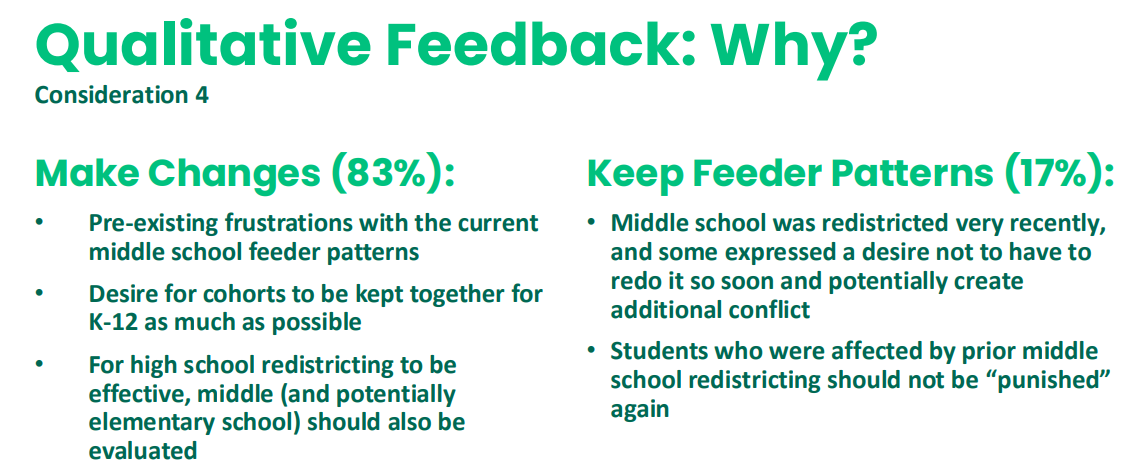
83% said the district should make changes to create better flow for high schools, vs 17% said to keep current feeder patterns together
44% said drive time should be used to determine proximity, 23% distance/mileage, 20% Other, 13% radius
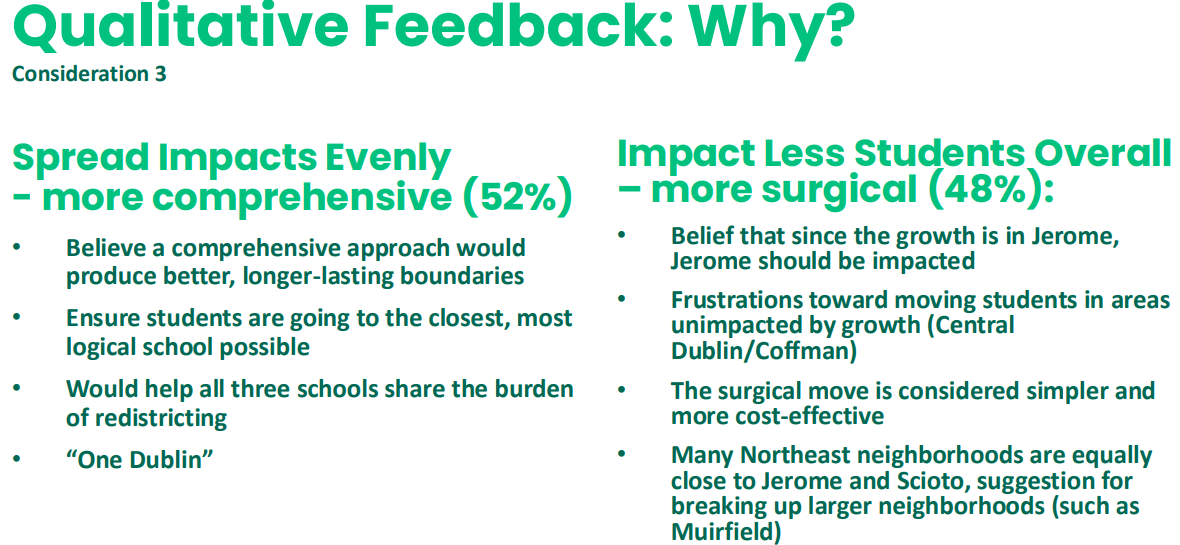
Residents want the least amount of students impacted!
A majority of residents think the existing feeder patterns need updated!
The results of the Fallon Survey showed:
63% are satisfied with the Dublin City School District, down from 74% in 2024
80% of residents rank the quality of education Dublin provides as very good/good with an equally strong opinion of our teachers.
38% think Dublin is doing a good job with spending its money and managing its finances, down from 49% in 2024.
34% think the quality of education differs greatly from school to school, up from 28% in 2024
54% said that the district should strive to minimize impact by reassigning as few students as possible
32% want to plan now for future growth so redistricting will serve the district longer
48% think that most of the information seen on social media is unfavorable towards Dublin schools, this is up for only 26% in 2024
73% think that the district should allow students who are already in high school to finish at the high schools at which they are already attending
55% disagree with existing feeder patterns and should change middle school boundaries to create better flow for new high school boundaries.
Planning NEXT Focus Groups:
Planning NEXT worked in partnership with the district to ensure a broad and representative pool of participants for the redistricting focus groups. To support this process, Dublin City Schools provided comprehensive stakeholder data, including rosters of current engagement groups, attendance and invitation lists from May 2024 focus groups, Board of Education public participation records, and participant lists from the October 22 high school redistricting listening sessions.
Using these datasets, Planning NEXT randomly selected individuals to invite to the March 2–10 focus groups. Group sizes ranged from 3 to 9 participants. A total of 177 individuals RSVP’d, with 153 ultimately participating.During the sessions, participants provide feedback anonymously via a worksheet and an online polling application called Mentimeter, allowing candid, real-time responses.
The focus groups were designed to test potential redistricting considerations and explore how the community weighs difficult tradeoffs. Participants were asked to respond to structured choices and then explain their reasoning.
Across the conversations, several consistent themes emerged:
A strong preference for planning with future growth in mind, even if it means more change now
Interest in providing flexibility for high school students to choose whether they stay at their current school or attend their assigned school
Openness to adjusting middle school feeder patterns to improve long-term alignment
Planning NEXT emphasized that these conversations were not about selecting boundaries, but about helping the Board refine the criteria that will ultimately guide those decisions.
Fallon Research:
The district partnered with Fallon Research to conduct a scientific community survey.
Using data supplied by the district, the parent study will be comprised of a combined total of approximately 300 to 400 SMS/text-to-web surveys (+/- 5.65 to 4.9 percent overall estimated margin of sampling error) among district school parents, which will cost $9,000. The study will include an interview schedule (survey instrument) comprised of approximately 10 to 20 closed ended questions (datapoints), including demographic questions.
Texts of the survey started early on Monday the 9th, but the text appeared to be SPAM and many people deleted it. A second survey was set via text later in the afternoon, looking a little more official, but this second survey had a different set of questions than the first. Only 5 of the questions were the same between the two surveys.
The public study will be comprised of a combined total of 400 telephone interviews and SMS/text-to-web surveys (+/- 4.9 percent overall estimated margin of sampling error) among adults 18 years of age and older residing within the Dublin City School District of Ohio, which will cost $21,000. The study will include an interview schedule (survey instrument) comprised of approximately 25 closed-ended questions (datapoints), including demographic questions, and, possibly, one open-ended question.
Fallon Research expanded the input process through two community-wide surveys, capturing responses from more than 1,100 residents and parents.
The survey results provided a broader snapshot of community sentiment and helped validate several themes heard in the focus groups.
Key takeaways included:
High confidence in the District’s educational quality, with strong ratings for overall education and classroom instruction
Heightened attention to redistricting among parents, who are following the issue more closely and view it as highly important
A clear preference among parents to minimize disruption for students, including strong support for allowing current high school students to remain at their school
Mixed perceptions around communication and financial management, signaling areas where continued clarity and engagement will be important
The survey also highlighted the complexity of community perspectives, with some responses showing uncertainty or differing views, particularly among residents without school-aged children.